


What a failed first attempt taught me about auditing a business before trying to fix it.
My first AI audit took two hours. One call with the founder, a handful of questions, and a slide deck delivered by Friday. At the time, I thought that was thorough.
A month later, the founder followed up. Response times were faster. A couple of workflows were cleaner. But revenue hadn't moved. Retention hadn't moved either.
I had fixed what the founder could see from the top of the business. I hadn't touched what was actually slowing it down underneath. That gap between what looks fixed and what actually changes is the reason I rebuilt the entire audit process, and it's worth unpacking, because it isn't a problem unique to me.
This is a pattern, not a one-off
It's tempting to treat a failed audit as a personal miss. It usually isn't. Research into how businesses actually implement AI keeps landing on the same conclusion: most initiatives don't fail because the technology is weak, they fail because the groundwork underneath them was never properly done.
MIT's NANDA initiative published the most detailed look at this to date in July 2025. Their report, The GenAI Divide: State of AI in Business 2025, is based on interviews with 52 organisations, a survey of 153 senior leaders, and a review of over 300 publicly disclosed AI deployments. The headline finding: despite an estimated $30 to $40 billion in enterprise GenAI investment, 95 percent of organisations were getting no measurable return on their profit and loss statement. Only 5 percent of pilots were actually extracting real value. The researchers were explicit that this wasn't a model quality problem. It came down to approach, specifically a failure to integrate AI into how the business actually works.
Gartner reached a similar conclusion from a different angle. In mid-2024 they predicted that at least 30 percent of generative AI projects would be abandoned after the proof-of-concept stage by the end of 2025, citing poor data quality, inadequate risk controls, escalating costs and unclear business value as the main causes. Worth noting that this was a forecast rather than a confirmed outcome, but the reasoning behind it lines up closely with what I saw in my own first audit: a project that looked promising on the surface but was never properly scoped against the realities of the business it was meant to serve.
Put those two together and a pattern emerges. Businesses aren't short on AI enthusiasm. They're short on the unglamorous groundwork that determines whether that enthusiasm turns into results.
Why founders can't see it, even when they're paying close attention
This isn't a knock on founders. It's a structural problem. Founders are running the business, not observing it from the outside. They see what surfaces in their own meetings, their own inbox, their own dashboards. They rarely have the bandwidth to sit with the person doing data entry at 4pm on a Thursday, or the support rep who's been quietly building a workaround for a broken handoff for the past six months. A two-hour call can only ever capture what's visible from the top.
McKinsey's research into large-scale transformations puts a number on how much this matters. Among transformations that failed to visibly engage line managers and frontline employees, only 3 percent of respondents reported the transformation as successful. Where line managers were engaged, that rose to 26 percent. Where frontline employees were engaged, it rose to 28 percent. The pattern holds regardless of how strong the plan looks on paper: without the people actually doing the work having a stake in the process, the initiative is likely dead on arrival.
There's also a piece of encouraging news buried in the same body of research, especially for the SMEs I work with. McKinsey found that organisations with fewer than 100 employees are 2.7 times more likely to report a successful digital transformation than organisations with more than 50,000 employees. Smaller businesses move faster, have shorter chains of communication and fewer layers between the founder and the front line. The advantage is there. It just isn't captured by a single call with the person at the top.
Rebuilding the audit around what's actually true, not what's visible
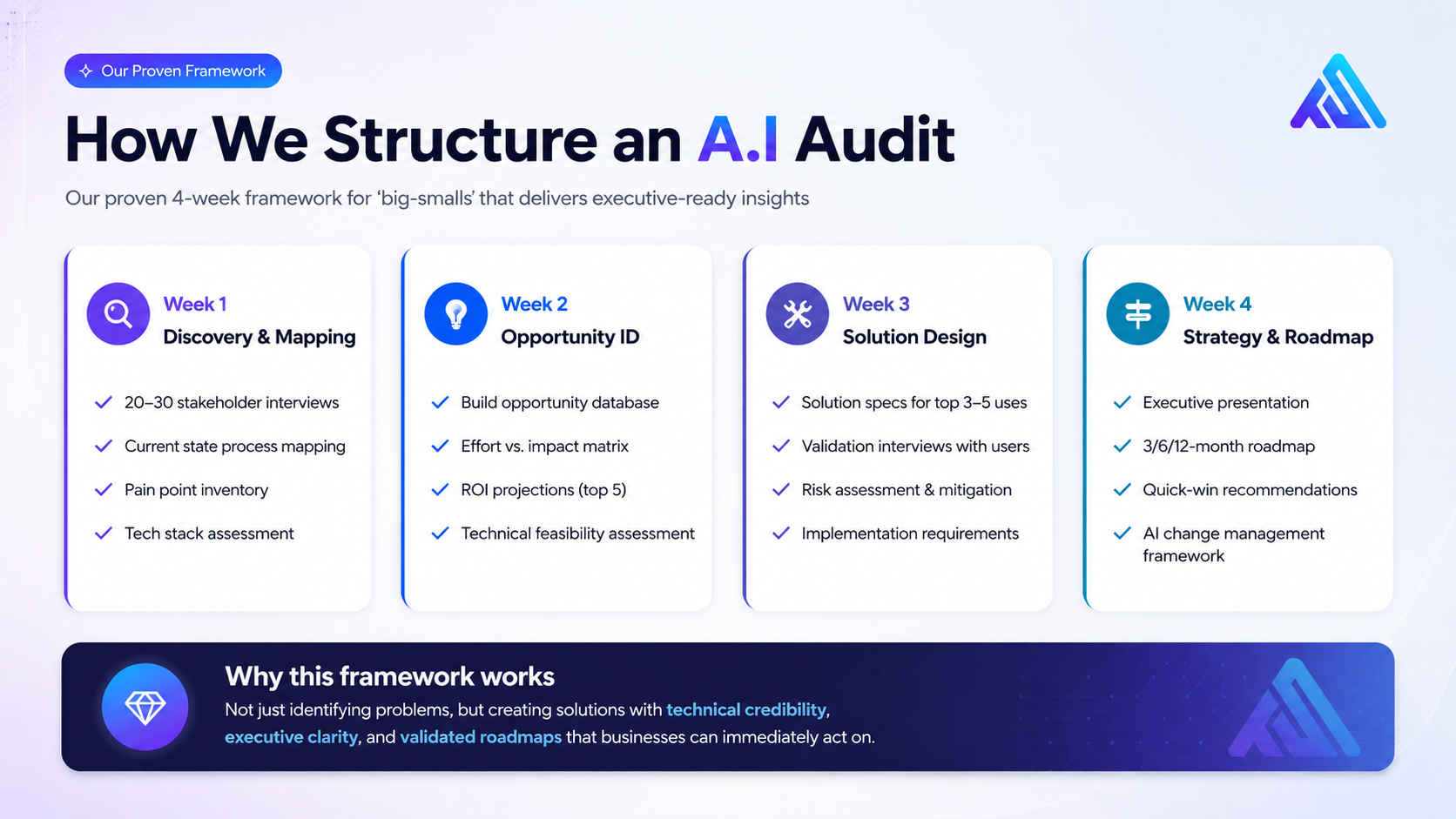
Once I understood the shape of the problem, the fix wasn't to work faster. It was to build a process that could actually reach the ground level of the business before recommending anything. That's now a four-week framework, and each week exists to close a specific gap that a shorter process leaves open.
Week 1: Discovery and Mapping
This is where the two-hour version of the audit used to end. Now it's just the starting point.
We run 20 to 30 stakeholder interviews, deliberately not limited to the founder or leadership team. That means talking to the people managing customer support tickets, the ones reconciling invoices, the ones fielding the same three questions from customers every single day. Alongside that, we build a current state process map so the business's actual workflows are documented as they run today, not as they're described in a strategy deck. That feeds into a full pain point inventory and a tech stack assessment, so we know exactly what tools are in play and where they're creating friction rather than removing it.
This is the week that catches what a founder simply can't see alone. It's also the most time-consuming week, and it's non-negotiable.
Week 2: Opportunity Identification
With the ground-level picture in hand, we build an opportunity database from everything surfaced in Week 1. Every candidate opportunity gets run through an effort versus impact matrix, a standard prioritisation tool that forces a clear-eyed comparison between how hard something is to build and how much it's actually worth building. ROI projections get attached to the top five opportunities, and technical feasibility gets checked before anything makes the shortlist.
This is the stage designed to catch exactly the failure points Gartner flagged: unclear business value, escalating costs, and technical assumptions that don't hold up once you look closely. Better to rule an idea out here, on paper, than six weeks into a build.
Week 3: Solution Design
The top three to five use cases get full specifications. Critically, those specs get validated with the actual users who'll be working with the solution day to day, not signed off by leadership alone. Risk assessment and implementation requirements get mapped out at this stage too, before a single dollar goes into development.
This is where the McKinsey frontline data becomes directly practical rather than theoretical. A solution that's been shaped by the person who'll actually use it every day is a solution people will adopt. One that's been designed in a boardroom and handed down rarely survives first contact with the real workflow.
Week 4: Strategy and Roadmap
The final week brings it together into an executive presentation, a 3, 6 and 12 month roadmap, a set of quick win recommendations to build early momentum, and a change management plan. That last piece matters more than it sounds. A technically sound recommendation that nobody adopts delivers exactly the same business result as no recommendation at all.
The actual takeaway
The businesses that get real value from AI aren't the ones who moved fastest. They're the ones who took the time to actually understand their business before they tried to fix it. That's not a slogan, it's the difference between an audit that produces a slide deck and one that produces movement in revenue and retention.
If you're a founder weighing up an AI audit for your own business, the question worth asking isn't how quickly it can be done. It's whether the process actually reaches the people who do the work, not just the person who signs off on the budget.
Sources
- MIT NANDA, The GenAI Divide: State of AI in Business 2025 (July 2025) — nanda.media.mit.edu
- Gartner, Gartner Predicts 30% of Generative AI Projects Will Be Abandoned After Proof of Concept By End of 2025 (July 2024) — gartner.com
- McKinsey & Company, The science behind successful organizational transformations — mckinsey.com
- McKinsey & Company, The keys to a successful digital transformation — mckinsey.com